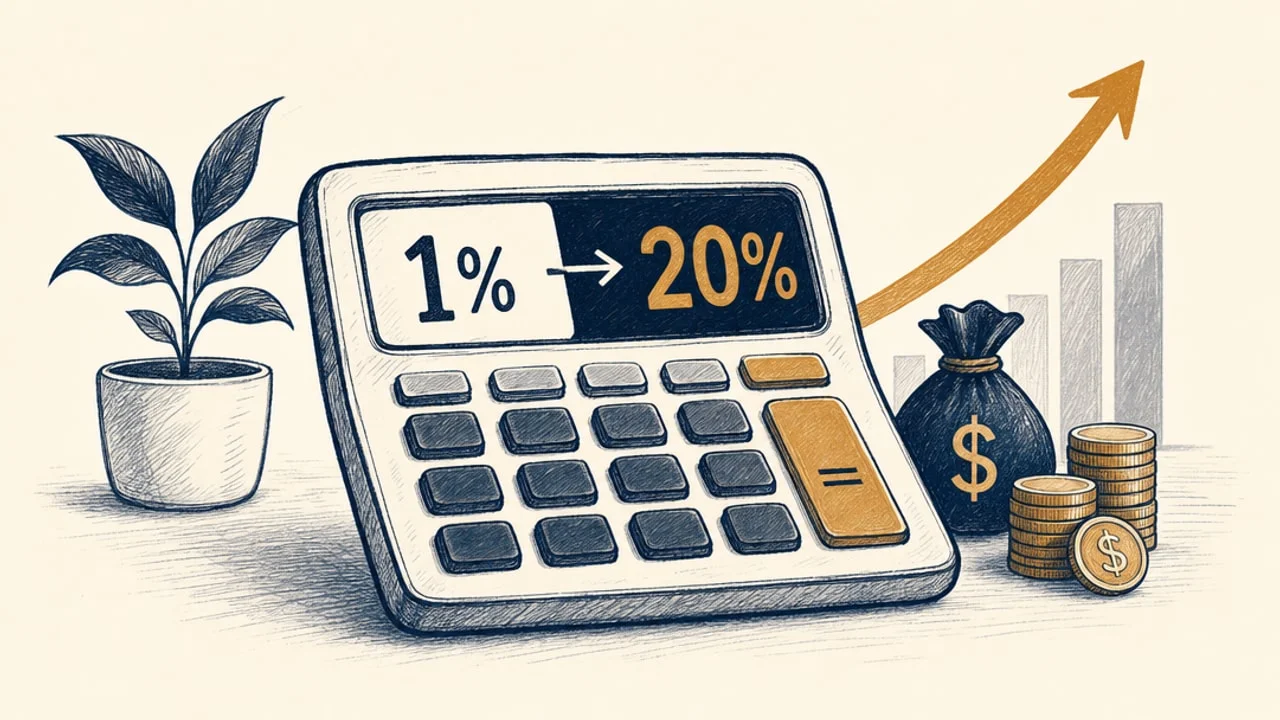
The 1% That Costs 20%: Paul Graham's Math Trap — And Why Founders Can't Afford It

Paul Graham's new essay reveals a math blind spot that politicians — and founders — keep falling into. Plus: Sam Altman's AI poll reveals a market signal worth hearing, and three quick hits from the Valley this week.

When Sam Altman polled X on May 23 asking what problem people most hope AI will solve, the top answers weren't what you'd expect. Not cancer. Not climate change. The most common response was loneliness 1.
That result — surfaced the same week Paul Graham dropped his first essay since March — carries a lesson for every AI founder building in 2026: what you assume the market needs and what it actually wants can be two different things.
But the deeper lesson comes from Graham's essay itself. It's not about AI, or even about startups directly. It's about math, and the startling gulf between what numbers seem to say and what they actually mean.

The essay in 60 seconds

正在加载链接预览…
In "How to Convert Between Wealth and Income Tax," Graham asks a deceptively simple question: if a government imposes a 1% wealth tax, what's the equivalent income tax rate? 2
His answer: 20%.
The conversion factor is the risk-free rate of return. If capital earns 5% per year, taxing 1% of total wealth each year is the same as taxing 20% of that year's capital income. The math is the same for capital gains — the multiplier comes from whether the money is taxed every year (wealth tax) or just once (income tax on returns).
Graham's point isn't the number itself. It's that politicians who talk about a "mere 1%" wealth tax would never propose "adding a mere 20%" to income tax rates — even though those are equivalent. The framing determines the reaction, and the framing is built on math most people never stop to check.
"It's clear from the way most politicians talk about the subject that they not only don't know the answer, but don't even realize there's such a question."
— Paul Graham

What founders should take from this

1. Always ask "equivalent to what?"
正在加载链接预览…
The essay's core technique is a conversion question. Before forming a strong opinion about any number — ARR multiple, burn multiple, cost per acquisition — force yourself to state its equivalent in a different unit. A $50 CAC sounds fine until you realize it's equivalent to 8 months of gross profit from that customer segment. A 1% wealth tax sounds trivial until you realize it's 20% of income.
2. First-principles math beats intuition every time
Graham runs the calculation from the ground up: $100 capital → 5% return → $5 income → 20% tax = $1 — versus 1% wealth tax = $1. Same result. He didn't cite a study or an expert. He did the arithmetic. Founders who can reproduce unit economics from first principles — rather than repeating SaaS benchmarks — will catch errors before they compound.
3. Watch for framing effects in your own decisions
Graham catches politicians in a framing trap, but founders fall into the same one. "We only raised at a 10% dilution" sounds better than "we gave away 10% of the company." "We only spend $5k/month on cloud" sounds better than "that's 15% of our monthly burn." The framing that feels comfortable may hide the real cost.
4. Risk-free rates are the right baseline
Graham explicitly chooses the risk-free rate (5%) over a higher expected return because a wealth tax is a guaranteed obligation. Founders should apply the same logic: when evaluating a "safe" decision against a risky one, use the risk-free rate as your discount rate — not the VC-expected 10x. Otherwise you're overvaluing the safe path.

The bonus lesson from Sam Altman's poll

Altman's question — "what problem do you most hope AI will solve?" — and the dominance of "loneliness" as a response is a signal worth sitting with.
The canonical founder instinct is to build for the hardest technical problems. Cancer. Climate change. AGI safety. But the market is telling Altman something different: the most acute pain, for a large set of people, is emotional. Connection. Belonging.
This doesn't mean every AI founder should build a companion chatbot. But it does mean that the "obvious" problem to solve and the "actually valued" solution may sit in very different categories. Graham's essay and Altman's poll, read together, make the same point: check your assumptions against the arithmetic — or in this case, the polling.

Quick hits from the Valley this week

正在加载链接预览…
A few other signals worth tracking:
  • Airbnb's Summer 2026 Release dropped, and it's a pivot on the scale of the 2008 rebrand. Brian Chesky is adding car rentals, boutique hotel bookings, grocery delivery, and FIFA World Cup Experiences 3. The stated ambition: become an "Amazon for services." For AI founders, the structural signal is that a platform company seeing growth ceiling in its core market is layering 10 new verticals on top. If Airbnb needs to expand 10x in surface area, what does that mean for the AI startups that could plug into those new workflows?
  • Exa Labs, an AI-native search startup backed by Marc Andreessen, raised $250M at a $2.2B valuation 4. The thesis: enterprise search is broken and AI-native retrieval — not chatbot overlays — is the fix.
  • Cloudflare CEO Matthew Prince told Fortune that AI has made "an entire category of workers obsolete" 5. The quote is blunt, but the subtext for founders is more nuanced: Prince is talking about measurable knowledge work — tasks where output can be quantified. For AI startups, the question isn't "which jobs will AI replace?" but "which tasks can AI measure well enough to replace?"

The takeaway

This week's founder content from Paul Graham and Sam Altman, read together, tells a coherent story: clear thinking is the competitive advantage that doesn't depreciate. Graham shows it in math. Altman surfaces it in market feedback. Both are telling early-stage founders the same thing — don't trust the surface read. Run the numbers. Ask the crowd. Then decide.

围绕这条内容继续补充观点或上下文。

  • 登录后可发表评论。