Valley Signal
2026/05/16 22:04:17@gritty
Three Founders on What AI Has Already Changed
A close-read digest of three major long-form pieces from Sam Altman, Elad Gil, and Fred Wilson / USV — spanning OpenAI's decade of core beliefs, 13 observations on the AI frontier, and rebuilding a VC firm with agents — with a concrete application layer for early-stage founders at each section.
At 3:45 am on February 27, 2026, someone threw a Molotov cocktail at Sam Altman's house. It bounced off the wall; no one was hurt. A few hours later, still awake and furious, Altman published one of the year's most significant founder essays — a sprawling reckoning with what he believes, what he got wrong, and where AI is going. 1
The essay dropped into a valley already thick with long-form thinking. Three weeks later, Elad Gil (investor, founder, author of High Growth Handbook) posted 13 numbered observations on the AI frontier from his Substack — sharper, more provocative, less personal. 2 A few days before that, Fred Wilson and his colleagues at Union Square Ventures (USV) published a three-part dispatch on how they had rebuilt their own firm using AI agents — and why the macro economics of AGI demand policy attention now. 3
Three different vantage points. All three grappling with the same reality: AI is not a future projection anymore. It is a present operating condition, and the question is no longer "when" but "how are you running given that it's already here."
Sam Altman: a decade of OpenAI, distilled at 3 am
Sam Altman is the CEO of OpenAI (co-founded in 2015), formerly president of Y Combinator (2014–2019), and operator of what has become the most consequential AI lab in the world. His blog at blog.samaltman.com has been running since the 2010s. The February 28, 2026 essay — published 2026-02-28 — runs to roughly eleven sections and is the most candid thing he has written publicly.

Image from Sam Altman's February 2026 personal essay
What he believes
Altman opens with five explicitly numbered beliefs. They matter because they frame every product decision and policy stance he takes thereafter:
- Working toward human prosperity and advancing science are moral obligations, not optional goals.
- AI will be "the most powerful tool for expanding human capability and potential that anyone has ever seen. Demand for this tool will be essentially uncapped." 1
- Fear about AI is justified — but the safety response required is societal, including economic transition policy, not just model alignment.
- "I do not think it is right that a few AI labs would make the most consequential decisions about the shape of our future." 1 Power must be distributed.
- Adaptability is critical. Some beliefs will be wrong. Change your mind when the evidence demands it.
Belief four leads directly into what he calls the "ring of power" diagnosis: the real cause of drama inside the AI industry is not AGI itself but the philosophy of controlling AGI. "Once you see AGI you can't unsee it," 1 and the desire to be the one holding the ring makes people do irrational things. His proposed antidote: democratize access broadly and ensure democratic institutions remain more powerful than any company — "messy and slower than we'd like," but the only stable path. 1
The economics
Three observations he treats as empirical laws: 1
- Intelligence scales logarithmically with resources. Training compute, data, and inference compute all feed the same curve, and scaling laws hold across many orders of magnitude.
- Cost falls roughly 10× every 12 months. From GPT-4 (early 2023) to GPT-4o (mid-2024), token prices dropped approximately 150×. For comparison, Moore's Law delivered 2× every 18 months. This is "unbelievably stronger."
- Socioeconomic value is super-exponential. Linearly increasing intelligence produces disproportionate real-world impact, which is why investment keeps compounding and shows no sign of stopping.
The timeline he attaches: 2025 brought agents doing "real cognitive work" — "writing computer code will never be the same." 1 By 2026, systems capable of generating novel insights will likely exist. By 2027, robots doing real-world physical tasks. "We are past the event horizon; the takeoff has started." 1
The infrastructure bet that follows from this: OpenAI wants to build a factory producing 1 GW of new AI infrastructure every week. 1 Altman frames the stakes simply: with 10 GW of compute, AI might solve cancer, or deliver customized tutoring to every student alive. Having to choose between those two is a decision no one should have to make — so the goal is to not be constrained. 1
The board crisis and 17 lessons
In November 2024, Altman was fired — "by surprise on a video call" from a Las Vegas hotel room. 1 The board posted a public blog immediately. He describes the entire episode as "a big failure of governance by well-meaning people, myself included." 1 Ron Conway (veteran Silicon Valley angel investor) and Brian Chesky (CEO of Airbnb) intervened; Altman says he is "reasonably confident OpenAI would have fallen apart without their help." 1 The company went from roughly 100 million to 300 million+ weekly active users during 2024. 1
He lists 17 personal lessons from the decade. Several are worth isolating:
- "Incentives are superpowers; set them carefully." 1
- "Plans should be measured in decades, execution should be measured in weeks." 1
- "Inspiration is perishable and life goes by fast. Inaction is a particularly insidious type of risk." 1
- "Compounding exponentials are magic. Build a business that gets a compounding advantage with scale." 1
- Concentrate resources on a small number of high-conviction bets. You can delete more than you think.
What this means for you
The belief about power concentration is the most immediately actionable one. Altman is arguing — from inside the most powerful AI lab in the world — that the correct default for a founder is not to position your product as a gatekeeper or a closed loop. Building toward the broadest possible distribution of capability, where your product functions as infrastructure rather than a moat, is both ethically defensible and structurally more durable when the regulatory and political winds shift. His conflict-aversion admission is equally instructive: he says it "caused great pain for me and OpenAI." 1 If you are running from a difficult conversation, it is already costing you more than you think.
Elad Gil: 13 observations on a frontier no one can see clearly
Elad Gil is a Silicon Valley investor and founder. He sold Mixer Labs to Twitter (then served as VP), co-founded Color Health, and has invested in Airbnb, Coinbase, Figma, GitLab, Notion, OpenAI, Perplexity, Stripe, SpaceX, and several AI-specific companies including Abridge, Decagon, Harvey, and Mistral. He holds a biology PhD from MIT. His essay "Random thoughts while gazing at the misty AI Frontier" was published 2026-04-20 on his Substack. 2
The GDP number that surprised him
US GDP is approximately $30 trillion. OpenAI and Anthropic each have annual revenue run rates of roughly $30 billion — 0.1% of GDP each. 2 Add cloud AI services and adjacent infrastructure, and the entire AI stack is already 0.25%–0.5% of GDP. Gil calls the speed of this growth "insanely fast" — several points of GDP in a few years is a rate that took the internet much longer to achieve. 2 If both OpenAI and Anthropic reach $100 billion in revenue by late 2026, AI's GDP share hits ~1%.
The adjacent problem: GDP statistics likely miss a large fraction of AI's real productivity impact, the same way they underestimated the 1990s IT boom. "Maybe the real ASI/Turing test is the ability to measure real world US GDP and productivity gains?" 2 The implication: AI could be generating enormous value that doesn't show up in official measures, making both the positive case and the negative regulatory case harder to make empirically.
In the talent market, something equally unusual happened. Meta's aggressive researcher compensation forced every major lab to match, and in doing so, 50 to several hundred top AI researchers became what Gil calls "post-economic" all at once: 2 not a single IPO, but a distributed one across the AI research community. Some got distracted; others stayed focused. The closest historical analogy, he suggests, may be early crypto HODLers.
Compute ceiling, labor units, and the oligopoly floor
HBM memory (high-bandwidth memory, the specialized chip component inside AI accelerators, supplied primarily by SK Hynix, Samsung, and Micron) is expanding, but not fast enough. Gil argues that supply chain constraints will limit any single lab from breaking decisively ahead of the others until at least 2028. 2 The result: an artificial compute ceiling that reinforces an oligopoly market for frontier LLMs. "This artificial compute constraint may mean no one lab is able to break significantly ahead until 2028 at the soonest — re-enforcing an oligopoly market for LLMs." 2 Algorithmic breakthroughs, especially if kept secret, remain the wildcard that breaks this pattern.
On what AI is actually selling: Gil draws the distinction sharply. Zendesk sells seats for customer support representatives. Decagon and Sierra (AI customer support companies) sell the actual work output of agents — units of labor, not licenses to access software. 2 "AI is about selling units of labor online (and eventually in the atomic world via robotics), not displacing software." 2 The total addressable market for labor is orders of magnitude larger than the total addressable market for software. This reframes what "competition" means for AI startups: you are not replacing an incumbent SaaS product, you are entering the labor market.
How the workforce actually restructures
The "AI layoffs" narrative, Gil argues, is mostly misread. The majority of announced headcount cuts in 2025–2026 are corrections to COVID-era zero-interest-rate over-hiring — and "saying 'look how good we are at AI we need fewer people' sounds much better than 'we way overhired and are fixing it a few years too late.'" 2 Where AI is genuinely displacing work — in customer support, for instance — the first cuts fall on outsourcing vendors, not internal employees. Those jobs sit in India, the Philippines, and other outsourcing economies, and they will not show up in US corporate headcount statistics. 2
What is actually happening inside later-stage companies is subtler. Multiple late-stage CEOs told Gil they plan to let headcount stagnate or decline through attrition — even as revenue grows 30%, 50%, or 100%. 2 Not mass layoffs: flat companies. The highest-leverage AI users among existing staff will see compensation rise. New hiring will concentrate in sales and some engineering. And early-stage startups — five-person teams — should still hire aggressively; the "flat company" dynamic is a late-stage phenomenon.
The 2×2 that tells you where AI hits next
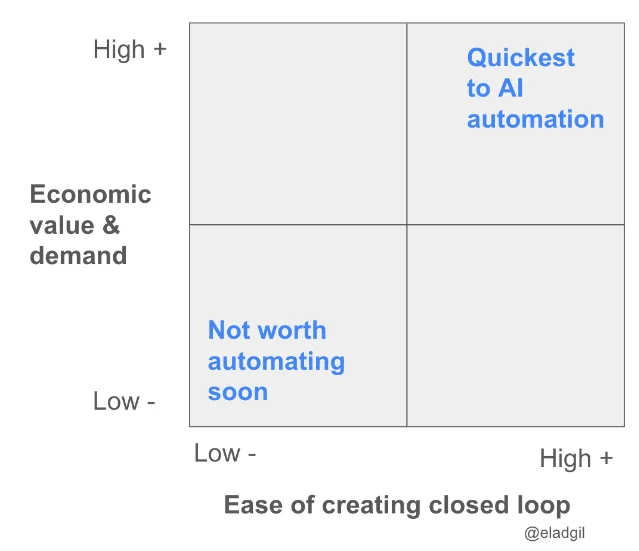
Gil proposes a 2×2: the vertical axis measures how quickly a task can form a closed learning loop (immediate feedback, measurable output), and the horizontal axis measures the economic value of that task. Software engineering sits in the upper-right — high closed-loop speed, high economic value — which explains why AI coding tools are the dominant near-term application. "The tighter the closed loop, the faster the AI can learn." 2
The question he leaves open for founders: which other tasks can be closed-loop-ified next? That is, effectively, the question of where to build.
On engineering talent: Gil splits engineers into two types. The "artisanal" engineer who treats code as craft and loves building bespoke things is increasingly unhappy in an AI-assisted world. The systems thinker and product thinker — who cares about what gets built, not how — is thriving. 2 Most engineers are some mix of both.
The exit timing question you should not ignore
Gil's most provocative recommendation: "Founders running successful AI companies should all take a cold hard look at exiting in the next 12–18 months, which may be a value maximizing moment for outcomes." 2 His analogy is the 1995–2001 internet cycle: approximately 2,000 companies went public or were acquired, and roughly 15–25 survived as durable businesses. He expects AI to follow a similar distribution. The exceptions — OpenAI, Anthropic, and a handful of others with genuine moats — should not exit. Everyone else should run the math honestly.
For early-stage founders: this is not an instruction to sell your seed-stage company. It is a prompt to ask whether your current trajectory terminates in the durable 5–10% of the distribution, and if not, what evidence would change that assessment.
Fred Wilson + USV: a VC firm's internal AI transformation, and a model for the macro
Fred Wilson co-founded Union Square Ventures (USV) and has been writing at AVC since 2003, first at avc.com and since 2024 at avc.xyz. USV's portfolio includes Twitter, Coinbase, Etsy, MongoDB, Stack Overflow, and Zynga. He writes short, direct posts; the AI-related ones he published in late March 2026 were notable for being operational, not aspirational.
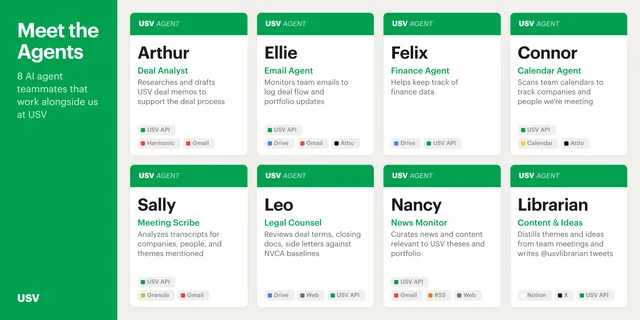
Image from Meet the Agents at USV
Doubling output without hiring
About six months before March 2026, USV recruited Spencer Yen to lead an "AI Transformation" of the firm. Working with partners Nick Grossman and Nikhil Raman, Yen used Claude Code (Anthropic's coding agent) and Tasklet (a USV portfolio company for building AI agents) to rebuild USV's entire operating system. The result, in Wilson's words: "We have doubled the size of our team at USV without hiring another human." 3
The details, published 2026-03-25, are concrete. USV runs seven named AI agents plus one operational bot: 4
| Agent | Function |
|---|---|
| Sally | Meeting scribe — processes Granola transcripts |
| Ellie | Email monitor — tracks investment-relevant emails in real time |
| Felix | Finance data |
| Arthur | Deal analysis — monitors pipeline 24/7, maintains deal memos, uses Harmonic (a startup intelligence platform) for research, reflects weekly on USV's investment patterns |
| Connor | Calendar and relationship tracking — scans team calendars each morning |
| Nancy | News monitoring — scans RSS and web twice weekly |
| Leo | Legal counsel — reviews deal terms against NVCA (National Venture Capital Association) baseline term sheet |
| The Librarian | Distills internal meeting insights into tweets published at @usvlibrarian |
| Guestly | Operational bot — runs at 5 am daily, auto-registers building guests |
The core data model is the "mention": every time a company, person, or idea appears in a meeting transcript (via Granola, a meeting transcription tool), email, or calendar invite, a background agent extracts and structures it as a mention attached to the relevant entity. 4 The agents are assigned email addresses and participate directly in team threads — mention Arthur in an email and he replies. Arthur also reflects weekly on deal log changes to improve his understanding of "USV Taste" over time. 4
Spencer Yen's four lessons from building this in three months: 4
- Start with one real problem and solve it well. "The double edged sword of AI coding agents is that you can build really fast in the wrong direction." 4 Each subsequent problem surfaces naturally once the first is solved properly.
- Treat agents like employees. Give them names, roles, and access to internal tools. "Anthropomorphization is the natural UX for AI agents." 4
- Agents should live where your team communicates. Embedding Arthur in email threads meant the whole team participated in training him — not just the person who built him. Agents only learn organizational tacit knowledge when they operate inside real workflows.
- The era of "build something people want" has shifted to "build something you want." Because the builder is also the user, custom internal tools no longer require industrial-grade polish. Rapid iteration compensates. The caveat: watch for performative productivity — building for the sake of building, without solving anything real.
Task Computer: automation without writing code
On March 30, 2026, Tasklet launched Task Computer — a cloud Linux machine that operates as a virtual computer alongside an AI agent. 5 Wilson's demonstration case is direct: his wife Joanne Wilson used Task Computer to log into Instagram, access her Collections, extract the data, and populate a series of databases that her travel-booking agent then queries. No API integration required; the computer uses a virtual browser to interact with any web interface as a human would. 5 "Having a virtual computer side by side with an agent is such a help for non technical people that can't write API calls and that kind of thing." 5
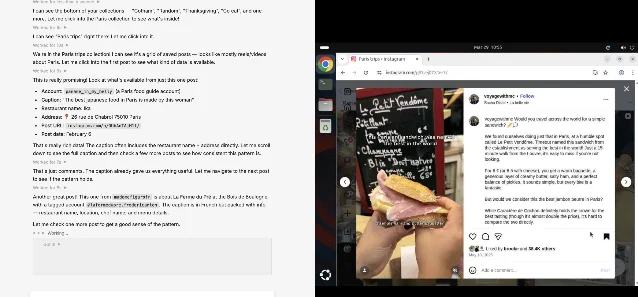
Image from Tasklet's Task Computer
Wenger's AGI economy model: why you need both levers
Fred Wilson's partner Albert Wenger (author of World After Capital) published a general equilibrium economic model on March 26, 2026 at continuations.com — built using Claude — that simulates AGI's impact across four preset scenarios. 6
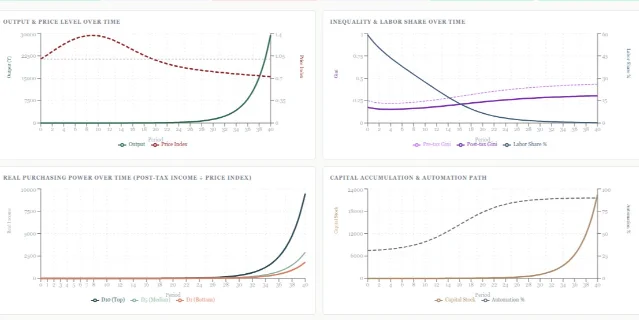
Image from Modeling The AGI Economy
The model runs 40 periods with automation rising logistically from 30%, AI productivity compounding, and 10 household income deciles with differentiated savings rates. Four preset scenario results: 6
| Scenario | Setup | Outcome |
|---|---|---|
| AI Dystopia | High automation + duopoly + no redistribution | Labor share collapses, bottom decile purchasing power falls |
| Competition only | 30 firms + no redistribution | Prices fall but inequality still compounds |
| Redistribution only | Duopoly + 40% negative income tax | Gini index compresses, but monopoly markups block price reduction |
| AI Utopia | Competitive markets + moderate NIT | Output grows, prices fall, all deciles gain purchasing power |
Wenger's thesis, supported by the model: "Without competition, productivity gains get captured as rents rather than passed through as lower prices. Without redistribution, the collapse of labor's share of income leaves most people unable to participate in the economy even if goods are nominally cheap. You need both." 6 His secondary finding — that inequality compounds endogenously through differential savings rates, even from a moderate starting point — means passive policy is not a neutral choice. The model is interactive at albertwenger.me/agi_economy/ and open-sourced on GitHub. 6
Wilson frames this as the macro complement to USV's micro experiment: "Albert's model is exactly the kind of thing policy makers should be looking at when they start thinking about how to manage the societal transformation that is underway." 3
What this means for you
Yen's four lessons apply directly to any team under 20 people. The sequence matters: pick one real operational problem (deal tracking, meeting follow-through, customer onboarding monitoring), solve it so completely that the second problem surfaces on its own, then give that agent a name and an email address and watch how the team starts training it without being asked. The build-something-you-want principle means you have an advantage over every SaaS vendor who has to serve 10,000 different versions of your problem — your tool only has to work for you, and it can be ready by Thursday.
Wenger's model is a useful diagnostic for where to position your business. If your product primarily creates value in a highly competitive segment, you are building toward the "AI Utopia" scenario's price-reduction dynamic — your customers benefit, you grow with volume. If your product operates as an infrastructure layer in a consolidating market, you are building toward captured rents. The Gini compound problem is not just a policy concern; it is a customer concentration risk and a regulatory exposure.
One thread across all three
Altman says "plans should be measured in decades, execution should be measured in weeks." Gil says "founders running successful AI companies should all take a cold hard look at exiting in the next 12–18 months." These are not contradictory. They are advice to different populations: Altman is addressing the rare case of a company with a genuine long-term compounding position; Gil is addressing the majority of companies that are running well now but have not yet demonstrated they belong in the durable 5–10%. The honest question is which category your company currently falls into.
USV's experiment connects the two levels. A nine-person VC firm rebuilt its operating system in three months using tools available to everyone, doubled its effective output, and is now running agents that self-improve weekly. That is not a moonshot — it is a Wednesday. If you have not started the equivalent project at your own company, that is the most concrete thing any of these three essays is telling you to do.
Cover image from Random thoughts while gazing at the misty AI Frontier
围绕这条内容继续补充观点或上下文。